
Link to the science paper
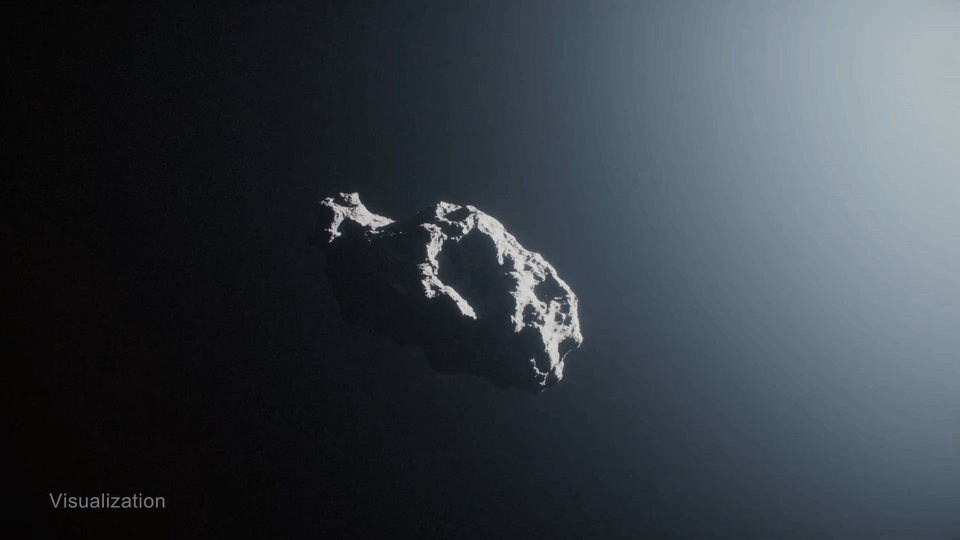
Astronomers using the Hubble Space Telescope have observed an unusual change in the rotation of comet 41P/Tuttle-Giacobini-Kresák. After passing close to the Sun in 2017, the comet’s spin slowed dramatically—from a rotation period of about 20 hours to as slow as 46–60 hours. Later observations showed it speeding up again to about 14 hours, suggesting that it not only slowed down but likely reversed its direction of spin.
This is the first time such behavior has been observed in a comet. Scientists explain this using jets of gas that erupt from the comet’s surface when sunlight heats its icy material. These jets act like tiny thrusters. If they are uneven, they can push against the comet’s rotation, first slowing it and eventually reversing it, similar to pushing a spinning merry-go-round in the opposite direction.
The comet is very small—about 1 kilometer wide—making it easier to affect its motion. Researchers also found that its activity has decreased significantly over time, possibly because surface ice is running out or becoming covered by dust. These rapid changes suggest the comet is evolving quickly and could eventually break apart if its spin becomes too fast.
Animation Credit: NASA, ESA, CSA, Ralf Crawford (STScI)
by Busy_Yesterday9455
15 Comments
Uh oh. Avi Loeb will be having a wank right now in anticipation before he writes another hack paper and calls all the news stations.

Did it fire thrusters? : )
I can hear it go ‘Wheeeeeeeeeeee’

We’ve all seen it in the ISS when the camera suddenly turns the other way around. Nothing new..
It has it’s own RCS!
Flip and burn BB!
Engage reverse thrusters!
That’s a good way to build a planetoid engine!
It intrigues me that, visually, the jet never seems to lose ‘intensity’ as it rotates, yet wouldn’t that suggest that it’s always facing towards the source of light/heat, which sort of can’t be happening in this circumstance?
Especially then considering that what we saw was several days’ worth of motion…
Me getting thrown out of the Taco Bell.
Is this AI?
Me every time I accidentally turn flight assist off
How is nobody freaking out about this? If it can happen to this comet it can happen to one closer to us and it could change its direction towards our planet within a very short notice.